

Tissot PRX Automatic Review
The Tissot PRX Automatic is the watch that made many people rethink what a few hundred dollars can buy. It pairs a 1970s-inspired integrated bracelet design with a modern movement that runs for three days off the wrist.
If you have been eyeing expensive steel sports watches and wincing at the prices, this one deserves a proper look. Here is what it is like to live with it, where it falls short, and who should buy it.
A Quick Look at the PRX’s Background
Tissot launched the original PRX in 1978 as a quartz watch during the boom in thin, steel-cased sports watches with built-in bracelets. The name stands for “Precision eXtreme”, which sounded ambitious even then. Tissot revived it in 2021 with a quartz version, and the automatic followed shortly after. That version, the PRX Powermatic 80, is the one watch enthusiasts talk about most.
Design and Wrist Presence
The standard automatic has a 40 mm stainless steel case, about 10.9 mm thick. That is slim for a mechanical watch, and it slides under a shirt cuff without catching. The bracelet flows straight out of the case, with a brushed and polished finish that looks more expensive than the price suggests.
Sizing matters here. The 40mm model wears on the larger side because the integrated lugs extend the footprint. If your wrist is under about 6.5 inches, try the 35mm version, which Tissot added later and which many smaller-wristed buyers prefer. A caveat is that the bracelet has no quick-release system, and the integrated end links make strap swaps awkward, so plan on wearing it as it comes.
The textured dial is the real star. Most versions have a fine “tapisserie”-style pattern that shifts between light and dark depending on the angle. Photos rarely capture it well.
What’s Inside: The Powermatic 80
The automatic PRX runs on the Powermatic 80 movement, which gives an 80-hour power reserve. In daily life, that means you can take it off Friday evening and still find it running on Monday morning. For anyone with more than one watch, that is a real convenience.
Later versions use a Nivachron hairspring, an alloy developed within the Swatch Group that resists magnetism and temperature swings better than a standard steel one. Magnetic fields from laptops, phone cases and bag clasps are where watches typically lose accuracy without you noticing. In practice, many owners report staying within a handful of seconds per day, though results vary between individual watches.
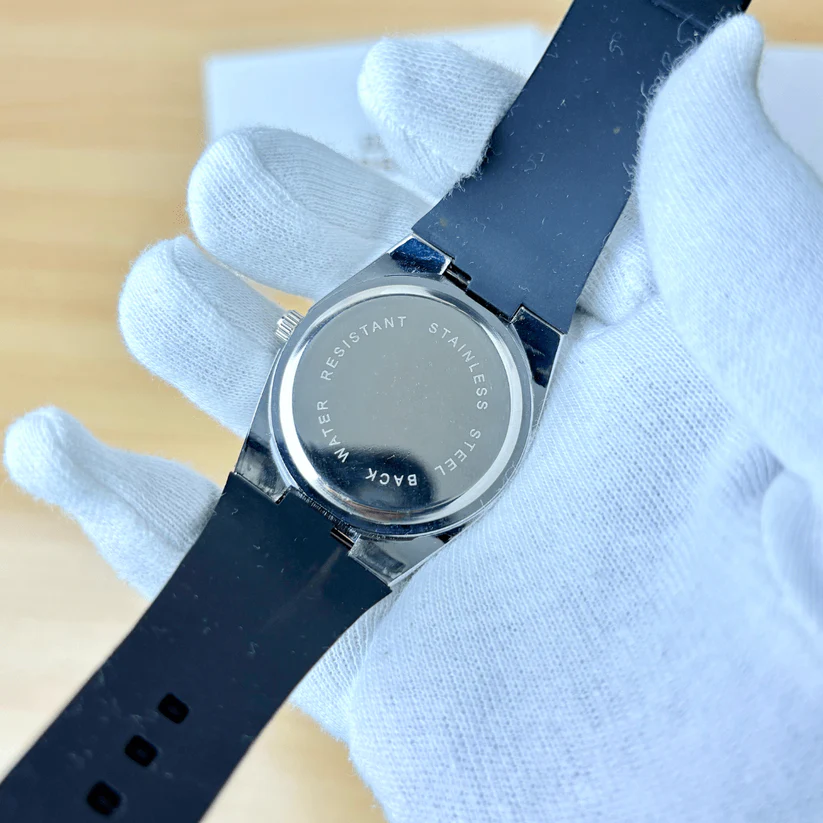
The case back is exhibition-style, so you can see the rotor moving. It is a modest finish rather than a showpiece, but it is pleasant to look at.
Dial Colours and Which to Choose
Tissot offers the PRX Automatic in several dial colours, including blue, green, black, silver and a few seasonal editions. A few practical notes from handling them:
- Blue is the safest all-rounder and works with both casual and business dress.
- Green looks quite dark indoors and comes alive in sunlight.
- Silver or white pairs well with a suit, but it shows fingerprints and wears a little more.
- Black is the most understated of the group.
If this is your first mechanical watch, the blue is hard to regret.
Living With It Day to Day
Water resistance is 100 metres, so swimming and showering are fine, although most owners keep a bracelet like this away from the sea for cleaning reasons. The sapphire crystal is scratch-resistant, which suits a watch you will wear constantly.
The slim profile is the biggest everyday advantage. Chunky dive watches can feel clumsy at a desk. The PRX does not, and it still looks right with jeans or a blazer. For one-watch collectors, that versatility is the main selling point.
The Drawbacks
No watch at this price is perfect. The bracelet clasp is functional but plain, and there is no micro-adjustment, so the fit can be slightly off between holes. The date window cuts into the dial’s symmetry, which some enthusiasts dislike. The lume is adequate rather than impressive. And because the PRX became popular so quickly, it is no longer a secret. You will see others wearing it.
How It Compares
Within the Swatch Group, a Hamilton Khaki Field Mechanical offers a different, more tool-watch appeal. Further afield, brands like Seiko and Citizen make capable alternatives, but few offer an integrated bracelet design with a three-day movement at this price. The PRX sits in a narrow niche, and that is partly why it sells so well.
Prices change by region and retailer, and promotions pop up. Checking an authorised dealer before buying is sensible, and so is confirming that the warranty is valid in your country.
Frequently Asked Questions
Is the Tissot PRX Automatic a good first luxury watch?
It is a good first serious watch, though “luxury” is a stretch. It offers strong design and a reliable movement for its price.
How accurate is it?
Many owners see only a few seconds of drift per day, but every watch varies. Keep it away from strong magnets, and have it checked if accuracy changes noticeably.
Does it need servicing?
Mechanical watches generally benefit from a service every several years. Follow Tissot’s guidance and your warranty terms.
Can I change the bracelet?
Not easily. The integrated design limits strap options, so most buyers keep the original bracelet.
Is the 35mm better than the 40mm?
Neither is better in general. Choose by wrist size and personal taste.
Final Thoughts
The Tissot PRX Automatic succeeds because it gets the fundamentals right: a distinctive case, an excellent dial, a long power reserve and a price that does not feel punishing.
It has small flaws, mainly the clasp and the lume, but they rarely get in the way of enjoying it. If you want a versatile, attractive mechanical watch without a luxury-brand budget, the PRX is easy to recommend. Try one on first, since sizing matters.


